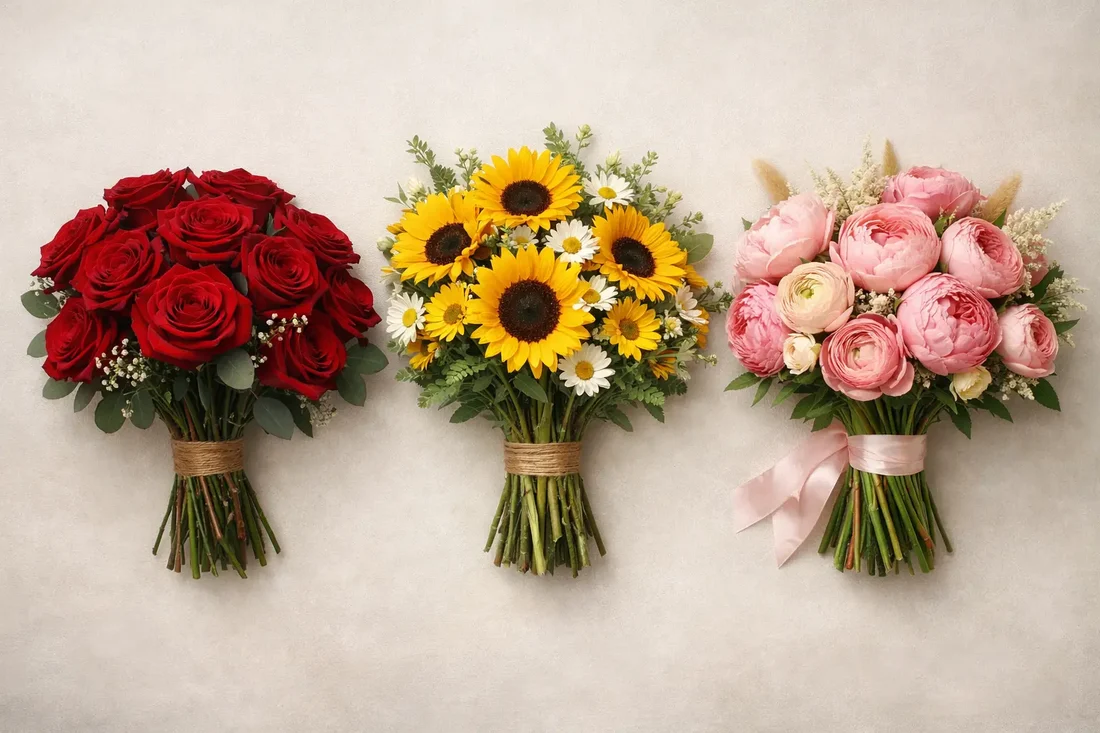
Most people judge a bouquet on the flowers. Florists judge it on the structure.
A happy birthday bouquet of flowers that looks expensive is usually not built from expensive stems. It is built with the right proportions: a few strong focal blooms, a supporting cast, texture, and enough foliage to give the whole thing shape.
Understand the recipe and you will brief your florist far better, and get noticeably more for your money.
The Anatomy of a Bouquet
Focal Flowers (roughly 20%)
The hero blooms your eye lands on first. Large, distinctive, and usually the most expensive part per stem. Dahlias, peonies in season, garden roses, waratah, king proteas, hydrangea heads, oriental lilies.
Three to five focal stems is plenty in a standard bouquet. More than that and they compete.
Secondary Flowers (roughly 30%)
Mid-sized blooms that fill the space between focals and carry the palette. Lisianthus, ranunculus, tulips, chrysanthemums, carnations, alstroemeria, gerberas.
This is where the volume lives, and where the best value is.
Texture and Filler (roughly 15%)
Small, airy elements that stop the bouquet looking solid. Wax flower, statice, thryptomene, gypsophila, berries, seed pods, grasses.
Texture is what makes a happy birthday bouquet of flowers look designed rather than assembled. Foliage (roughly 35%)
Eucalyptus, ruscus, native foliage, magnolia leaf, monstera. Cheap, structural, and responsible for most of the apparent size.
This is why a foliage-forward brief gives you a bigger bouquet for the same spend.
Palettes That Read as Celebratory
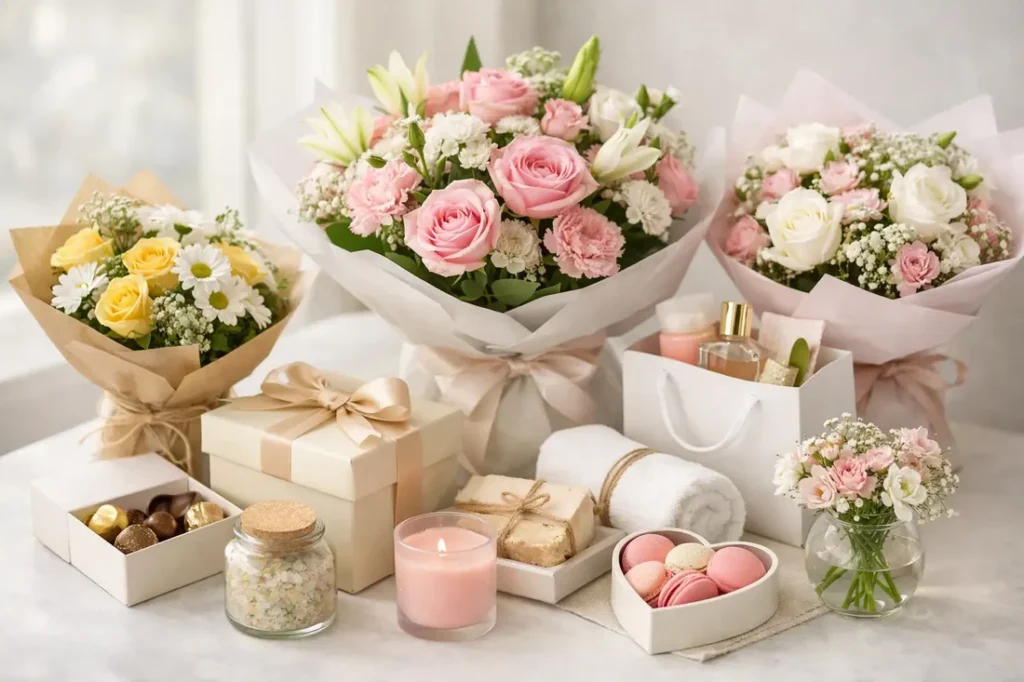
Mixed brights. Hot pink, orange, yellow, coral. The default birthday palette, and it works on almost everyone.
Tonal pink. Blush through to fuchsia in one family. Sophisticated, unmistakably feminine, very photogenic.
Sunshine. Yellows, golds and creams. Warm, friendly, unromantic in the best way. Perfect for friends and colleagues.
Jewel tones. Burgundy, plum, deep orange, bronze foliage. Excellent for autumn and winter birthdays and for anyone with more serious taste.
Native. Rust, olive, silver-grey, dusty pink. Structural, long-lasting, and distinctly Australian.
White and green. Elegant and calm. Just check the recipient does not associate white flowers with sympathy.
Sizing Guide
Petite (around 12 to 18 stems, $55 to $70). A genuine gesture. Right for colleagues, neighbours and thankyous.
Standard (around 20 to 30 stems, $75 to $110). The gift size. Reads as generous. Right for most birthdays.
Large (35 to 50 stems, $120 to $180). A statement. Family, partners, milestones.
Luxe (50+ stems or feature flowers, $200+). For once-in-a-decade occasions and gatherings where the flowers need to hold a room.
If you are hesitating between two sizes, take the larger one. Nobody has ever received too many flowers.
How to Brief Your Florist
Say four things and you will get the best possible happy birthday bouquet of flowers for the money.
- The number. “$95.”
- The occasion. “40th birthday, close friend.”
- The mood or palette. “Bright and joyful, lots of texture.”
- The freedom. “Designer’s choice from the best stems today.”
That brief lets the designer build from what is genuinely good that morning. Naming three exact flowers does the opposite: it constrains the buy and shrinks the bouquet.
Seasonal Notes for Sydney
Spring: the best value of the year. Ranunculus, tulips, sweet peas, stock, blossom branches.
Summer: dahlias, hydrangeas, sunflowers, gerberas, lisianthus. Ask for heat-tolerant stems and morning delivery.
Autumn: chrysanthemums, proteas, banksia, berried foliage. Longest vase life of the year.
Winter: tulips, anemones, ranunculus, hellebores, flowering gum. Cool weather means excellent longevity.
Urban horticulture is a serious field in Australia, and the University of Melbourne’s Master of Urban Horticulture covers exactly why: the environmental, social and health value of vegetation in cities. Cut flowers sit at the retail end of that same industry.
Vase Life and Aftercare
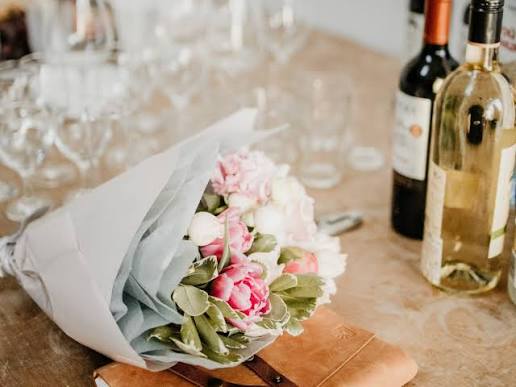
Unwrap immediately. Re-cut every stem two centimetres on a sharp angle. Strip foliage below the waterline. Clean vase, fresh cool water.
Change the water every second day and re-trim while you are there. Keep away from direct sun, heaters, airconditioning vents and fruit bowls. Remove spent stems promptly.
On that regime, expect ten to fourteen days from a well-conditioned seasonal bouquet, and longer from natives.
When it is finally done, the stems are garden organics. Mosman Council’s green waste service takes dead flowers, prunings and foliage and turns them into compost and mulch. Every Sydney council runs something equivalent.
Common Mistakes
- Naming three specific flowers instead of a palette.
- Choosing a size down to afford an add-on.
- Sending soft-petalled blooms to an unattended doorstep in February.
- Fully open blooms with no buds, so the bouquet peaks on day one.
- Leaving the card blank or unsigned.
- Ordering from a florist across the harbour instead of one in the recipient’s suburb.
Frequently Asked Questions
How many stems should a birthday bouquet have?
Twenty to thirty for a standard gift bouquet. Stem count matters less than the balance of focal, secondary, textural and foliage elements.
What is the longest-lasting happy birthday bouquet of flowers?
Australian natives, then chrysanthemums and carnations. Two to three weeks is realistic.
Hand-tied or vase?
Hand-tied for homes, vase for offices, hospitals and anyone who will not get around to trimming stems.
Should I ask for fragrance?
Only for homes. Strong scent is unwelcome in shared offices and some hospital wards.
Can I request no lilies?
Always say so if there are cats in the house. Lilies are genuinely toxic to them.
Is a bigger bouquet always better?
For gifting, yes. Volume is what registers at the door and reads as generosity.
The Takeaway
A great happy birthday bouquet of flowers is 20% focal blooms, 30% secondary flowers, 15% texture and 35% foliage, built in season and sized one step up from what you first considered.
Give your florist a budget, an occasion, a mood and the freedom to choose. That brief beats a shopping list every single time.